I thought that this might be a good time to post an update on developments.
So far, 38 centres have volunteered to pilot the qualification from August - which is more than I would like for the pilot but we're hoping to accommodate everyone who wants to be involved. The volunteers range from secondary schools to training centres so it looks like a good cross-section of the education community will be involved.
Some time ago, we produced the paper assessments for the unit and we're currently busy developing the teaching and learning material. A number of practicising teachers and lecturers are working on this material. I'm hoping that it will be finished by the end of this month.
I'm talking to a number of online assessment companies to find one to host the questions. Once one is selected, we have to get the questions onto the system so that they are available to schools and colleges for the start of term.
We're also planning the launch event, which will provide pilot centres with an opportunity to test the teaching and learning material, and try to online assessments.
And, finally, we are about to arrange another Steering Group meeting so that the partner organisations know what's going on.
Wednesday, July 26, 2006


Monday, July 24, 2006
Tuesday, July 18, 2006
Ofcom report on Online Protection
Ofcom has recently produced a report [PDF] on how best to protect consumers from potential abuses on the Internet. The key findings make interesting reading.
Monday, July 17, 2006
Friday, July 14, 2006
Internet safety FAQ
The first version of the FAQ for this project is now available. It answers the most commonly asked questions about the project in general and the qualification in particular. You can download it here - or here if the last link doesn't work.
This is the first version of the FAQ and it will grow over time so please provide feedback if there's anything you would like changed or added.
This is the first version of the FAQ and it will grow over time so please provide feedback if there's anything you would like changed or added.
Wednesday, July 05, 2006
Friday, June 30, 2006
Good response to request for pilot centres
So far, 24 centres have come forward to volunteer to pilot the new Internet Safety qualification. There's a good mix of centres including schools, colleges and training centres. The qualification looks particularly popular with S1/S2 pupils since several of the pilot centres indicated their intention to offer it to this group.
The pilot centres will be provided with digital teaching and learning material, and access to an online assessment bank. This qualification is part of SQA's E-only initiative so paper materials will not be provided. However, the unit itself will be available to any centre from August.
We haven't yet made a final decision about pilot centres and there's still time to volunteer. Contact Derek McFarlane if you're interested.
The pilot centres will be provided with digital teaching and learning material, and access to an online assessment bank. This qualification is part of SQA's E-only initiative so paper materials will not be provided. However, the unit itself will be available to any centre from August.
We haven't yet made a final decision about pilot centres and there's still time to volunteer. Contact Derek McFarlane if you're interested.
Thursday, June 29, 2006
Tuesday, June 27, 2006
Thursday, June 08, 2006
Pilot centres wanted
I am in the process of writing to centres to ask for volunteers to pilot the Internet Safety unit. But you don't need to wait for the letter to arrive since you can contact Derek McFarlane if you want to be involved in delivering this unit.
A key aspect of this project relates to innovative ways to teach and assess the unit and I'm looking for a number of pilot centres to test the learning and assessment material, which will be supplied in digital format (consisting of HTML teaching materials and an item bank of questions for formative and summative use).
At this stage, I'm only looking for expressions of interest - not commitments (on either side). So please contact Derek by e-mail if you're interested in becoming involved in the pilot.
A key aspect of this project relates to innovative ways to teach and assess the unit and I'm looking for a number of pilot centres to test the learning and assessment material, which will be supplied in digital format (consisting of HTML teaching materials and an item bank of questions for formative and summative use).
At this stage, I'm only looking for expressions of interest - not commitments (on either side). So please contact Derek by e-mail if you're interested in becoming involved in the pilot.
Tuesday, June 06, 2006
Cyberbullying
Sunday's Times newspaper carried a story on cyber-bullying (which features in the Internet Safety unit!).
Monday, June 05, 2006
Working weekend
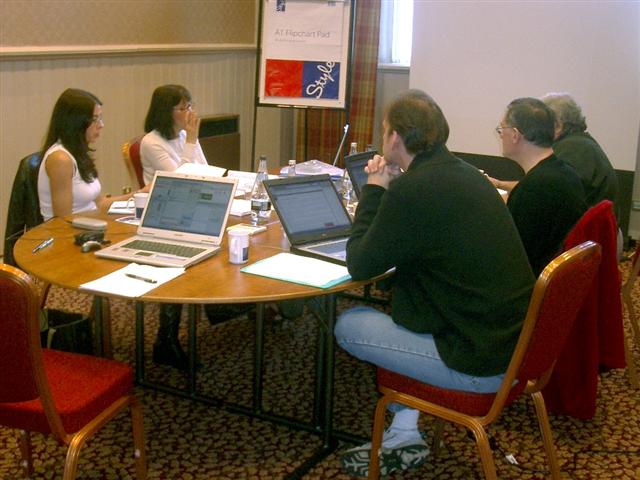
I'm just back from a working weekend in Stirling where a team of writers produced the assessments for the Internet Safety unit.
The work was pretty intensive. From Friday evening to Monday afternoon, the team produced over 200 questions for Outcomes 1-3 and developed an assessment for Outcome 4. I was particularly pleased at the multiple choice questions. Not only were a very large number produced - but they were high quality questions too.
These questions will be added to an item bank which will be used as the basis of an online assessment system for this Unit.
Final version of unit specification
Thanks to everyone who responded to my invitation to comment on the draft unit spec.
I've now made some changes to the unit and I think that it's much improved. Here is the final version. Note that it is not yet numbered and still has the "draft" watermark. You can locate the changes by comparing this version to the previous version.
I'll now arrange for the unit to be published and added to SQA's list of qualifications. It will be available to (all) centres from August. But I'll be looking for centres to pilot the "e-only" approach to the unit shortly.
I've now made some changes to the unit and I think that it's much improved. Here is the final version. Note that it is not yet numbered and still has the "draft" watermark. You can locate the changes by comparing this version to the previous version.
I'll now arrange for the unit to be published and added to SQA's list of qualifications. It will be available to (all) centres from August. But I'll be looking for centres to pilot the "e-only" approach to the unit shortly.
Thursday, May 25, 2006
Draft unit specification is now available for comment
A draft unit specification [DOC] is now available for comment. The writing team would appreciate comments via this blog.
First meeting of the Steering Group
The Steering Group for this project met for the first time yesterday. Representatives of the BBC, Learning & Teaching Scotland, Scottish libraries, Strathclyde Police attended along with school and college representatives. It was a very positive meeting with support for developments to date and an endorsement of the planned future action.
There was a strong consensus around the general approach that should be embodied within the qualification and associated materials -- education not prohibition. It was noted that many centres often banned access to many Internet resources but it was felt that this simply transferred the problem to outside of school - where pupils often had unrestricted access at home or Internet cafes or (increasingly) on mobile devices. So the qualification should seek to educate users to use the Internet responsibly rather than attempting to control access.
There was a strong consensus around the general approach that should be embodied within the qualification and associated materials -- education not prohibition. It was noted that many centres often banned access to many Internet resources but it was felt that this simply transferred the problem to outside of school - where pupils often had unrestricted access at home or Internet cafes or (increasingly) on mobile devices. So the qualification should seek to educate users to use the Internet responsibly rather than attempting to control access.
Tuesday, May 16, 2006
Survey results are now available
Over 500 people completed the online survey - which means that we can have a lot of confidence in the results. The main points of interest are:
The proposed qualification will be revised to reflect these findings. A draft version of the unit specification will be available later this week.
- 95% of respondents were "somewhat" or "very" concerned about Internet safety
- 80% of centres had an Internet safety policy but...
- one third of those centres "sometimes" or "never" enforced it
- 40% of centres provided some form of Internet safety training but...
- this was "informal" in 80% of those centres.
- downloading inappropriate material
- accessing inappropriate material
- making inappropriate friendships.
The proposed qualification will be revised to reflect these findings. A draft version of the unit specification will be available later this week.
Monday, May 15, 2006
Social networks
Techweb reports that almost half of Internet users visited a social networking site last month. Websites such as MySpace and Faceparty have become incredibly popular among young adults. Some concerns have been expressed about the use of such sites although social networking looks like it will continue to grow.
Friday, May 12, 2006
Teachers lack knowledge on internet safety, report reveals
Teachers feel uneducated about protecting children from inappropriate websites and do not know who they should to turn to for advice, new research reveals. More.
I was surprised at the report's claim that "the largest group of viewers of internet pornography was children aged 12 to 17".
I was surprised at the report's claim that "the largest group of viewers of internet pornography was children aged 12 to 17".
Thursday, May 11, 2006
Online resources
One of the more interesting parts of this project is the opportunity to review online resources relating to Internet safety. I've come across a large number of websites, some based in the UK and some international.
The BBC has a large number of online resources such as ChatGuide, organisations such as BT and Microsoft sponsor more technical information such as Get Safe Online, some sites provide specific advice to particular users such as Yahoo's Parents' Guide, and the Children's Charity provides a useful Internet safety FAQ.
International sites of note include the Australian government's NetAlert service and the Oklahoma Police Department's comprehensive guide to identity theft.
Let me know (by posting a comment here or sending me an e-mail) if you know of any other useful online resources.
The BBC has a large number of online resources such as ChatGuide, organisations such as BT and Microsoft sponsor more technical information such as Get Safe Online, some sites provide specific advice to particular users such as Yahoo's Parents' Guide, and the Children's Charity provides a useful Internet safety FAQ.
International sites of note include the Australian government's NetAlert service and the Oklahoma Police Department's comprehensive guide to identity theft.
Let me know (by posting a comment here or sending me an e-mail) if you know of any other useful online resources.
Subscribe to:
Posts (Atom)